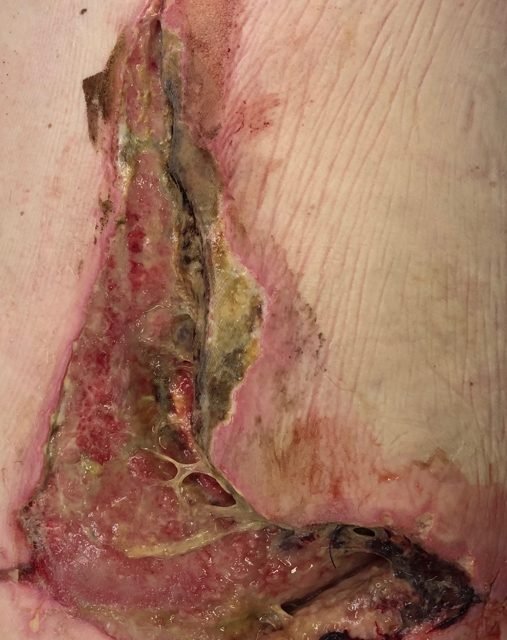
This man suffered a blast injury overseas that left extensive wounds on his back. He had already been through a colostomy and several operations, including flap reconstruction, and had partial paralysis of the legs. After moving to Dubai he was referred to Dr Sanjay and his team.
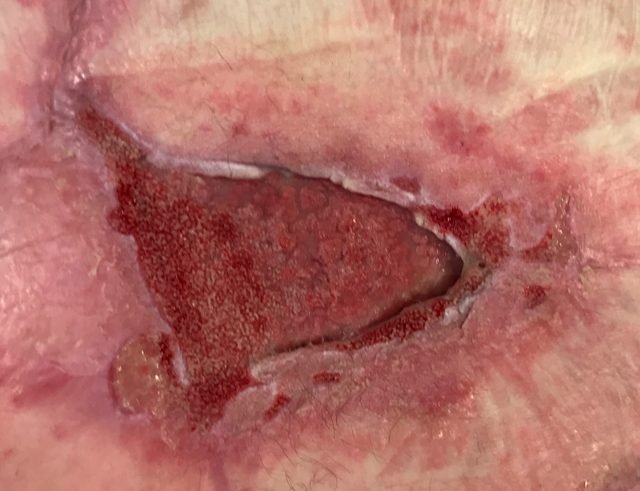
He was paying for his own treatment without insurance, so the team planned care that could be given as an outpatient wherever possible. After a thorough examination, they started VAC therapy with minimal debridement in the clinic. Over 6 weeks of VAC dressings the wound and the surrounding skin improved steadily.
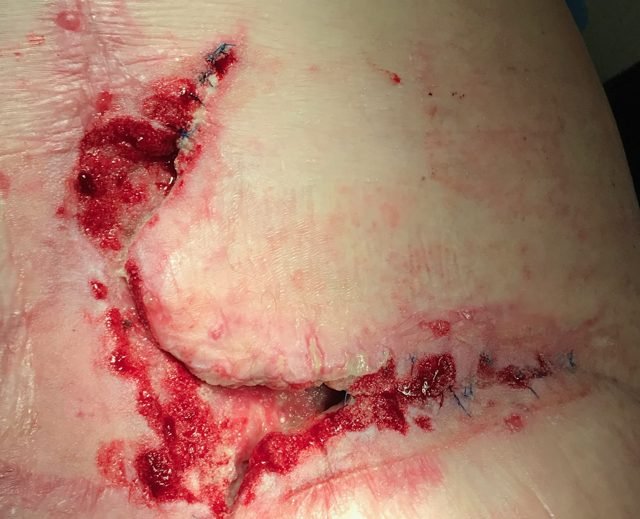
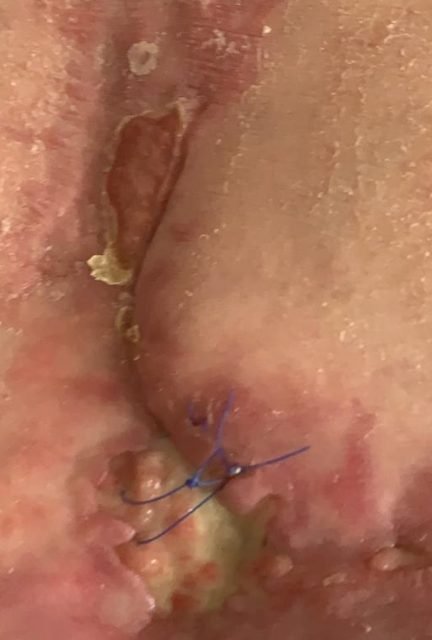
To speed up healing, he was admitted for a short procedure: a small rotation flap under local infiltration anaesthesia, which reduces bleeding and the risk of a haematoma. Internal anchoring sutures held the skin, and a modified VAC dressing encouraged the surrounding skin to move over the wound. The approach relies on creeping substitution, where healthy living tissue gradually replaces damaged tissue, a principle first described in bone healing[11] and seen in skin as "creep", the gradual stretching and growth of skin under steady tension that underlies tissue expansion[7,8,9]. It also aims to stimulate the body's own repair cells: VAC therapy has been shown to draw progenitor (stem) cells into healing[4,5,6], and skin and fat naturally contain multipotent repair cells such as Muse cells[12]. The wound healed completely in 8 to 10 weeks.
- Cause
- Blast injury abroad; previous colostomy and flap reconstruction
- Problem
- Extensive non-healing back wound; partial paralysis; self-paying, no insurance
- Treatment
- Outpatient VAC with minimal debridement for 6 weeks, then a small rotation flap with anchoring sutures and modified VAC
- Result
- Completely healed in 8–10 weeks, mostly as an outpatient
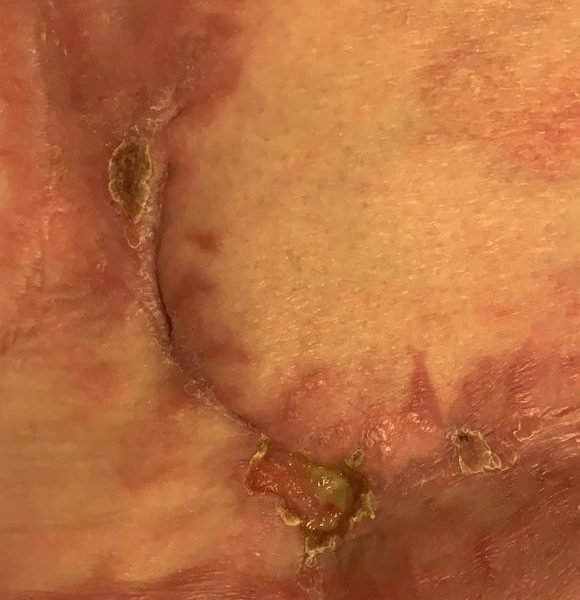
These photos show open wounds.