This young patient had liposuction, arm lifts (bilateral brachioplasty) and thigh lifts (thighplasty) in another country. Within 48 hours she became unwell and her haemoglobin began to fall. She had developed necrotising fasciitis, a rapidly spreading infection often called “flesh-eating bacteria”. She was admitted to intensive care with septic shock and needed multiple IV antibiotics, blood transfusions and several wound debridements, which left large open wounds on her arms and thighs.
When she was brought to Dubai her vital signs were stable but her haemoglobin was still low. Dr Sanjay and his team admitted her, gave a blood transfusion and examined the wounds in the operating theatre. They judged the wounds clean and ready to be closed straight away. She had been advised to have skin grafts, but grafts would have meant new wounds and new scars at the donor sites.
“In reconstructive surgery we often rob Peter to pay Paul. Here we enriched Paul to pay for himself.” Dr Sanjay Parashar
Under light anaesthesia (laryngeal mask and local infiltration), the team gently mobilised the surrounding skin, placed anchoring sutures and applied VAC therapy. Together, the internal and external anchorage let the surrounding skin stretch and advance over the wounds, using the skin's natural ability to "creep" under steady tension, the same principle behind tissue expansion[7,8,9,10]. At 48 hours the wounds were checked, she felt better, and the VAC was reapplied before she went home, after only 2 days in hospital. When this second VAC dressing was removed 5 days later, one week after the operation, the wound edges had started to come together. She went back to work and is now on a scar treatment programme.
- Procedure
- Liposuction, arm lifts and thigh lifts done abroad
- Problem
- Necrotising fasciitis with septic shock, ICU stay and large open wounds after repeated debridement; low haemoglobin
- Treatment
- Blood transfusion, skin mobilisation with anchoring sutures and VAC therapy instead of skin grafts
- Result
- 2 days in hospital; wound edges coming together at one week, no donor-site scars; back at work, scar therapy under way
In the press: Gulf News report on this case (5 October 2022)
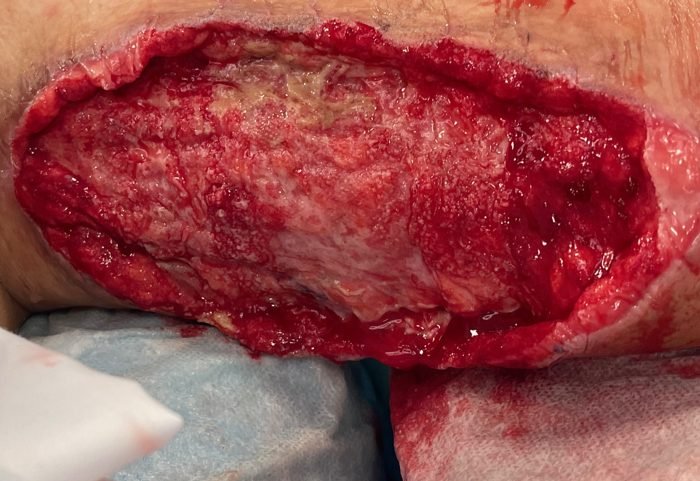
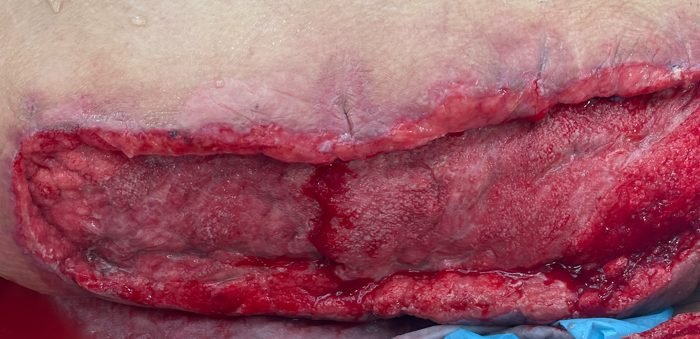
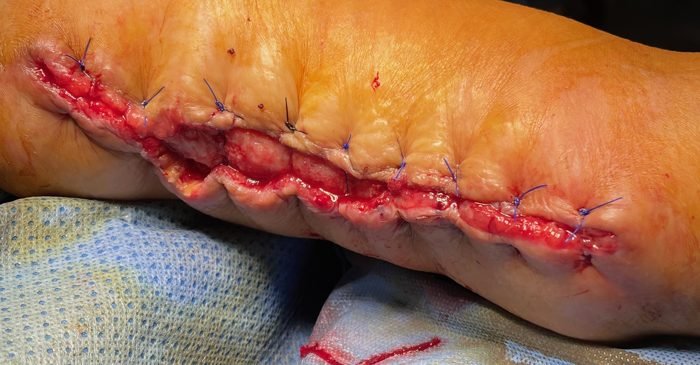
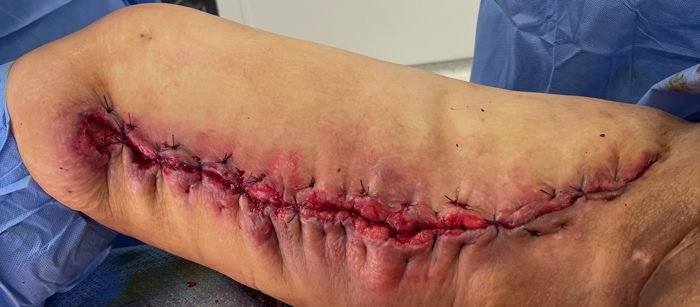
These photos show open wounds.